

Do you want to improve your finances? Discover 15 important things to track every month to control spending, save more, reduce debt, grow your net worth, and build wealth.
A bold finance mission is not always about making more money, cancelling everything you enjoy, or investing in an ambitious strategy.
Often, the biggest improvement comes from just knowing where your money is going!
Ironically, you know roughly how much money you make a month. But can you tell me off the top of your head how much you spent on groceries last month? How much have your savings increased? How much debt do you pay off? Or the cash that vanishes in silence via subscriptions, fees and small purchases?
Most people cannot.
And that is exactly why it can be so useful to keep an eye on the finances each month.
Your finances no longer must be a mystery when you keep tabs on these few key numbers regularly. You identify patterns in your spending, nip problems in the bud, set practical targets, and decide more wisely what to do with the money that you currently possess.
You can check your bank account only ten times a day. You perform a basic financial review every month that serves you well to tell you how your financial wealth is doing.
Here are 15 things you should track every month to improve your finances, save more money, reduce debt, and build long-term wealth.

1. Your Total Monthly Income
Let’s begin with the easiest number: What money did we receive this month?
Do not just presume it is identical to the final thirty-day period.
Your income may include:
- Salary or wages
- Overtime
- Freelance income
- Business income
- Side-hustle earnings
- Bonuses or commissions
- Investment in income
- Rental income
- Other sources of income
Monthly monitoring becomes even more essential if your income is variable.
You don’t budget based on what you think will bring in but begin developing a realistic picture of your average income.
Based on the example, with 11 months that would be $5,200, $4,600, $5,500 and $4,800. If you build a lifestyle around a guaranteed income of $5,500 monthly there could easily become an issue.
Following your income allows you to spot something else as well: Is your income really growing?
2. Your Total Monthly Spending
Then, figure out how much you spent in that month.
This number can be surprising.
It’s easy enough to disregard a few $20 purchases as unimportant at the time they are made.
However, 100 multiple small purchases along with bills, groceries, restaurants and added stations can easily light hundred – or thousand – on a monthly basis!
Compare your total income with total expenditure.
You earn $5,000 but spend $4,850 so your financial margin is just $150.
That’s important information.
First, you do not have to aim for drastic spending reductions. Rather, focus on creating enough distance between your income and expenses.
Saving, investing, paying off debt and building wealth happen in that gap.

3. Your Fixed Expenses
These are your expenses that are relatively the same each month (or at least, you hope will be).
These may include:
- Rent or mortgage
- Car payments
- Insurance
- Internet
- Phone bills
- Childcare
- Loan payments
- Memberships
Tracking these individually shows you how much of your income is already earmarked before the month begins.
Let’s say you are making $5K/month and already have $3200 committed towards fixed costs.
That translates to 64% of your earnings being committed before you buy food, do errands, or drive anywhere for entertainment (outside the home) or pay for savings and unexpected expenses.
This percentage can tell you whether your lifestyle is becoming unavoidable compared to the income.
4. Your Variable Expenses
These are the expenses that tend to vary from one month to another.
These typically include groceries, restaurants, gas, clothes, entertainment, household supplies and personal care.
Typically, most control people have.
You aren’t going to be able to pay down your mortgage tomorrow, but you might identify that you spent $620 on eating last month.
We are not trying to make you feel guilty.
My goal is to ask:
Was that purchase worth it?
If it was, fine.
If not, well you just found a way to repurpose that money to something more meaningful.
5. Your Savings Rate
Out of all the stats related to finance, your savings rate has one of the highest values.
A simple calculation is:
Savings Ratio = [Amount Saved / (Take-Home Income)] * 100
Assuming you take home $5,000 and save $750:
$750 ÷ $5,000 × 100 = 15%
Your savings rate is 15%.
Tracking the percentage allows you to see whether you’re getting better at keeping more of what you earn instead of merely focusing on the dollar amount.
Increasing your savings rate by 1% or 2% at a time can be impactful over the span of years.

6. Your Emergency Fund Balance
Your emergency fund is worthy of a line item on your monthly tracker.
Why?
Because emergencies don’t schedule appointments.
Cars break down.
Appliances stop working.
Jobs change.
Family emergencies happen.
Unexpected bills arrive.
Monthly, write down the amount of your emergency fund and check it against what you want to have saved up.
For example:
Current emergency fund: $6,000
Monthly essential expenses: $3,000
Emergency savings: 2 months
So, if your target is six months of living expenses, you already have $12,000 still to go.
That converts an imprecise target such as, I need a little savings into realistic goal.
7. Your Debt Balances
If you are working towards debt-free, just track your payments.
Track the remaining balances.
Just list out the details for each debt, like current balance, interest rate, minimum payment amount and any additional payments you may want to make.
Seeing a balance going from $9,800 to $9,200 then to $8,400 can provide real encouragement.
And you can also see if your pay down strategy is really working.
Give priority to high-interest debt, especially from credit cards.
Interest can slyly eat up money that could have gone to building the nest egg or making investments.
8. Your Credit Card Spending
And even if you wipe your cards out at the end of every month, track what you’re charging.
If you pay cash, then money is literally leaving your hand; when it comes to credit cards however, buying something only seems real once the bill arrives.
One $15 transaction here, another for $48 there and a third of about $70 online can easily lead to an unexpectedly large statement.
Do month-by-month credit card spending comparisons
If it increases suddenly, check the reason behind.
The idea isn’t to quit any finances at Everyplace.
It is to ensure you oversee the card, instead of it controlling your spending habits.
9. Your Subscription Costs
Streaming platforms.
Apps.
Software.
Cloud storage.
Gym memberships.
Meal services.
Premium memberships.
Individually, they look inexpensive.
Combined, they can really add up to a serious monthly cost.
Track subscriptions and write down every charge you are put under contract.
Then ask yourself three questions:
- Do I use it?
- Do I need it?
- Would I buy it again today?
If the answer is no, think about cancelling it.
Every $50 a month in non-essentials means $600 annually.

10.- Your Grocery and Dining-Out Spending
Food is the number one easiest budget category to sell yourself short.
That’s why I recommend separating:
Groceries
From – Restaurants, Takeout, Coffee, and Food Delivery.
You may think you are spending $700 a month on food, only to learn that you are actually spending $700 on groceries and another $450 at restaurants and delivery.
The honest number today, however, is $1,150.
When you see that number, you’ll have a choice to decide if you’re still okay with it.
If not, create monthly food budgets for groceries and dining out separately.
11.- Your Sinking Funds
Not every big expenditure is a cause for panic.
Christmas happens every year.
Funny how birthdays, holidays, premiums of insurance, school fees/apparels/car safety net for maintenance/property taxes/recurring annual renewals avec subscription all come knocking at your doorstep.
This is where sinking funds shine.
By having a sinking fund, you can put away a small amount of money each month for an expense in the future.
To have $1,200 for holiday shopping in 12 months, save:
$1,200 ÷ 12 = $100 per month.
Track the balance monthly.
By the time December comes you will not have to charge all of the holidays on a credit card.
12.- Your Financial Fees and Interest
This category is frequently overlooked.
Are you tracking how much you’re paying in?
- Credit card interest
- Bank fees
- Overdraft fees
- ATM charges
- Late fees
- Loan interest
- Investment account fees
These expenses do not enhance your life. In most walk their a burden of economic waste.

13.- Your Investments and Retirement Contributions
Please do not see the return on investing this month as whether the stock market went up or down.
Markets fluctuate.
What you can control and what I want to draw your concentration towards instead is this:
How much did you contribute?
Maximum contributions to retirement accounts, brokerage accounts, education accounts and a variety of other investments.
When you are investing for decades, consistency is a huge thing.
Finally, if your salary did increase substantially with the higher interest rate on your debt, then use that boost to gradually build up your contributions rather than losing every pay rise into lifestyle inflation.
14.- Your Net Worth
It gives you a wider view of the real status of your financial journey.
The formula is simple:
Net Worth = Assets − Liabilities
Assets could be money, bank accounts, savings, home investments and other assets of value.
Credit cards, student loans, personal loans, car loans or mortgages can also be classified as liabilities
Let’s say your total assets amount to $120,000, and your liabilities add up to $75,000.
Your net worth is:
$120,000 − $75,000 = $45,000
Don’t worry if your number is below where you’d like it to be.
The more important question is:
Is your net worth moving on the right path?
Even if that increase is from 25000 —>30000 —> 38000 within a time span of years, you are moving forward.
15.- Your Progress Toward Financial Goals
And lastly, monitor the goals behind those numbers.
Money is a tool. This is not just about stuffing numbers in a spreadsheet.
Maybe you’re saving for:
- A home
- A vacation
- Retirement
- Your children’s education
- Starting a business
- Paying off your mortgage
- Becoming debt-free
- Building a six-month emergency fund
- Reaching your first $100,000 invested
At the close of each month, you log on to your beginnings, where you stand now and what is left.
You cannot measure a goal like “save more money”.
Brace yourself for this one, because I imagine it is the most achievable goal of all time: “My emergency fund will be built from $5,000 to $15,000 by December 2027.”

Real Monthly Money Routine That Works
Covering 15 separate financial metrics may seem like a heavy lift, but at the same time, there’s no reason to spend hours doing it.
Schedule 30–60 minutes once a month to check in on your personal finances.
Go over your bank and credit card transactions, make sure to update the budget, take note of account balances, make any necessary debt adjustments, check on how savings and investments are performing and track progress towards goals.
Then answer four simple questions:
- What went well this month?
- Where did I overspend?
- What unexpected expenses came up?
In the next one month, what will I change and do?
This is what makes financial tracking useful.
You are not simply recording history. You use last month’s numbers to make next month’s decision better.
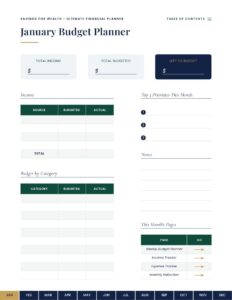
Simplify Your Monthly Money Tracking with – The Ultimate Financial Planner.
If you try to keep your budget, some savings goals, debt payoff plan, bills and everything else a smattering of notebooks, spreadsheets apps and scraps of paper, then it becomes quickly maddening.
This is why maintaining a single organized financial planning system can offer so much value.
The Ultimate Financial Planner – Editable Canva Edition was designed with your financial organization in mind.
All 105 pages can be found in editable Canva templates, so you can personalize the pages to your goals, style and finances.
You will also be given the complete hyperlinked PDF edition for easy digital reference on a tablet or in Four printable paper sizes,
You can choose from both the Dollar and Currency-Neutral versions, so it’s utilized whether you budget in USD or any other individual currencies.
Use it to create a financial wheelhouse for use with budgeting, saving, tracking expenses, setting goals, and just getting intentional with your money.
[SHOP THE ULTIMATE FINANCIAL PLANNER — EDITABLE CANVA EDITION HERE]

How Tracking Your Money Affects the Way You Handle Finances
Tracking works for one simple reason,
Once you measure, it becomes hard not to pay attention.
$20 and $30 purchases sound a lot less significant when you never see them considering the total restaurant spending overtime.
The annual total changes your perspective once you find it.
Saving is the same way.
Shuffling $200 into savings seems almost meaningless. Seeing your balance increase from 2000 to 4,400 to $7,000 — it gives you visibility into progress.
And visible progress creates motivation.
You also start noticing patterns.
Perhaps there are months when your spending goes up no matter what. Perhaps you consistently underestimate groceries. Perhaps your side hustle has paid off and you are making more money than you were two years ago, but you still cannot maintain the same level of savings.
It may be hard to see those patterns when you’re simply looking at individual transactions.
MONTHLY TRACKING GIVES THE BIGGER PICTURE.
Avoid the temptation of trying to have a “Perfect” Financial Month
A common pitfall that many fall into with budgeting is trying to be too perfect.
But this is not the case in real life.
One month of your energy bill could be bigger. Another month you need new tires. Another could be for a birthday, holiday, medical bill or home repair.
Just because something unexpected happened, it does not make your budget a failure.
Tracking your finances is never supposed to be about making every month the same way as the next.
It aims to help you understand the nature of what happened and how to best equip yourself for the next one.
This is the reason your budget should not be abandoned, even if you over-spend this month.
Review it.
Adjust.
Learn from it.
Then start again next month.
The ability to produce consistently is much more valuable than perfection.

Here is My Final Thought: Understand Your Numbers and Get Your Finances Under Control.
You do not have to become obsessed with every penny in order to improve your finances.
But you need to know your numbers.
These 15 things you should start tracking every month:
- Total income
- Total spending
- Fixed expenses
- Variable expenses
- Savings rate
- Emergency fund balance
- Debt balances
- Credit card spending
- Subscriptions
- Grocery and dining-out spending
- Sinking funds
- Fees and interest
- Investment and retirement contributions
- Net worth
- Progress toward financial goals
Even in your first monthly review, you might not love every single number.
That’s okay.
The numbers are not there to haunt you.
They are there to inform you.
When you learn what is going on with your money, you can determine what is happening now.
You can reduce expenses that you no longer care about. Increase your savings. Pay down debt faster.
Prepare for future expenses. Invest more consistently. And slowly but surely create a life that allows for more freedom in your finances.
You certainly do not have to change your finances in the flick of a switch.
Track. Review. Adjust. Repeat.
For that every month, and a year from now, you may be amazed at how different things look.

Ready to Organize Your Finances?
If you also want a more structured way to manage your budget, savings, and goals related to finances as well as money planning in general, check out the Ultimate Financial Planner – Editable Canva Edition.
105 editable Canva pages + complete hyperlinked PDF edition + four printable sizes + Dollar and Currency-Neutral versions.
→ [GET THE ULTIMATE FINANCIAL PLANNER HERE]